


Performers
Location

About
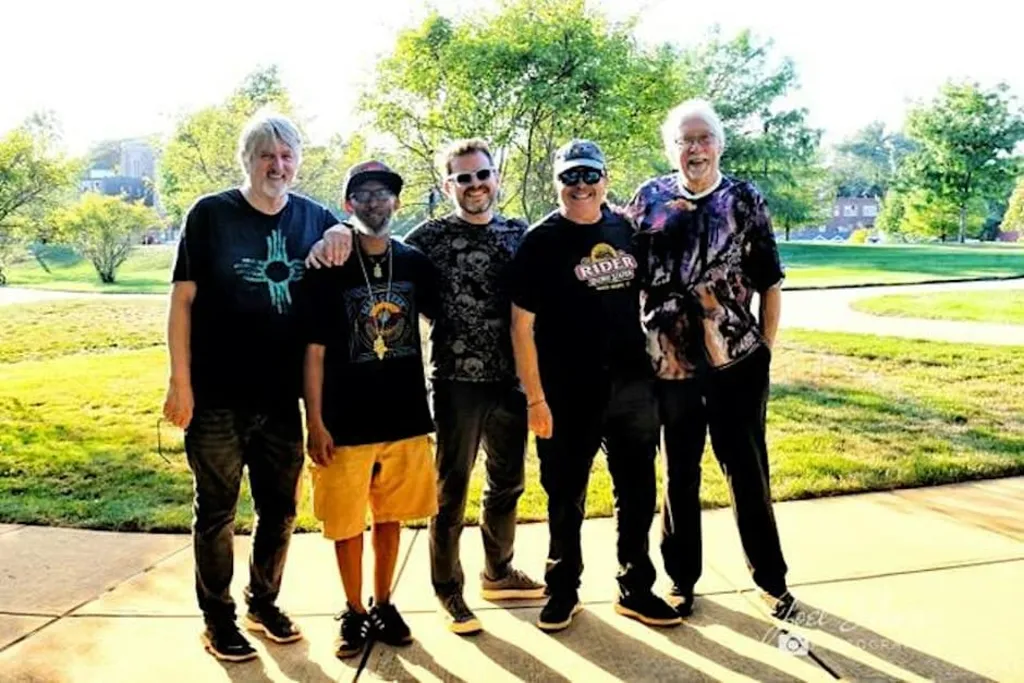
Max Creek makes their debut performance at Lark Hall on Friday, January 15th. Doors at 7pm; show at 8pm.
Max Creek was formed in 1971 as a quartet with, believe it or not, an accordion player, and went to a trio almost immediately: guitarist Dave Reed, fellow Hartt School student and bassist John Rider, and drummer Bob Gosselin. Their first big show was at Arlo Guthrie’s Mapleview Ballroom in Washington, MA (later to become “Woody’s”). They settled into a steady series of shows at the Rocking Horse in Hartford at a time when the social consciousness scene was taking hold pretty much everywhere, and Woodstock was fresh in everyone’s minds. They latched on to that idea, adopting Country/Folk/Rock as their style for covers and original tunes. They also discovered almost immediately that “jamming”—taking tunes in unplanned directions—was more fun than doing them the same way every night.
A 15-year-old trumpet student of Dave’s, Scott Murawski, who was also a guitar whiz, was asked to join. He lasted a few months before being kicked out of the Rocking Horse for drinking a beer onstage while underage. The band went on as a trio. Over the following Christmas break, Dave became ill with appendicitis. Coming from a family of Christian Scientists, he could not go to the hospital until it had burst and it was almost too late. To play an upcoming series of shows, John asked his former Hartt roommate and keyboardist Mark Mercier to fill in. Mark came back early from Christmas break with his family in Maine and, after a couple of intense rehearsals, played the shows. Dave recovered, Mark stayed on, and shortly afterward Scott rejoined; his age was never discussed with the club owners. Dave then left to pursue a solo career, and the basic band as it is known today was formed. They discovered singer Amy Fazzano while she was a waitress in Hartford, singing as she cleaned the bathrooms after a gig, and later asked percussionist Rob Fried to join.
The band toured extensively, playing as many as 200 shows a year. They were known to play to as many as 1,300 fans every week at two Providence venues, the Living Room and Lupo’s. When Max Creek toured, Phish would occasionally fill in at the Living Room until their return. On a couple of trips to Georgia, they co-billed with Widespread Panic, who taught them about the secrets of Jägermeister.
In 1992, Scott, having recently married and started a family, decided to take a step back from touring, and the rest of the band did likewise. As time went on, the playing schedule picked up, and the band decided that two-week trips to places like the West Coast and Colorado were better than a steady regimen of touring.
Amy left to get married, and Rob Fried, on hiatus from the band, sadly passed away in 2007. Bob Gosselin left in the early ’80s and was replaced by Boston drummer Greg DeGuglielmo, who stayed until 1992. He was replaced by Connecticut drummer Greg Vasso, who stayed until 1996. After his departure, another Connecticut drummer, Scott Allshouse, took over. In 2012, drummer Bill Carbone and percussionist Jamemurrell Stanley took charge of the batterie.
One of the highlights of every year from its inception is Camp Creek, a weekend-long camping festival that has happened, with interruptions, every year since 1983. The concept was new to the East Coast back then, and that year they held two: the first on August 6 and 7 in Granby, CT, and the second in Bowdoinham, ME, in a field behind a saltwater farm on the bay marshes. Since then, Camp Creek has been held at several places, including Arrowhead Ranch in New York, Stepping Stone Ranch in Rhode Island, and Indian Lookout Country Club in Duanesburg, NY. After a few years without one, it returned to Indian Lookout Country Club in 2014.
I think that the reason we are still together is that we spared ourselves the rigors of the road later, when it would be more physically taxing, and each show became something to look forward to. We never lost musical freshness, gave ourselves room to be individually creative with new ideas with as little judgment as we could muster, and, honestly, we sublimated like crazy. A policy of non-confrontation, a la Robert Hunter’s rules of Rock and Roll (to paraphrase: “don’t confront – talk about all absent parties when not there”) became the rule of the day. It was understood that although this went on, it was temporary and we all still love(d) each other. It sure gave us an outlet, though. Dr. Phil would never approve.
The band has become like the home that we return to when we need to feel comfortable, creative, and able to be ourselves—like going home for Thanksgiving or the holidays. I believe that one great attraction our audience feels is this precise thing, and the band has become more than a musical entity—it is a way of life for literally thousands. One of John Rider’s stated reasons for starting the band was to “give people that might not be accepted anywhere else (kind of like ourselves) a place to be.” For any one of us to stop now would be like cutting off a needed limb—it’s unimaginable.
- 4 hours
- Ages 21+
- In person
- Free parking
- No refunds